Gokyo Lakes Nepal
Gokyo Lakes Circuit
Sagarmatha National Park, Nepal
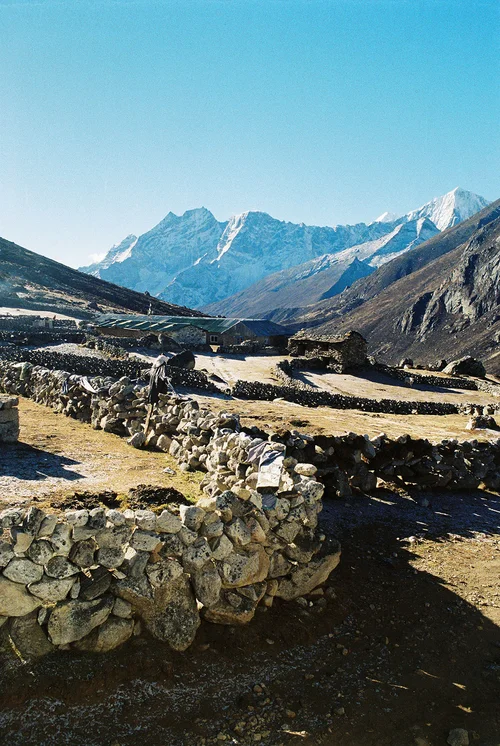
One of the other hikes in Sagarmatha National Park that is not EBC.
Flying into Lukla on a seventeen person plane, the first 3 days of the trail are shared with trekkers heading to Everest Base Camp. The trail is dusty and well-worn, with many people getting catching the ‘Khumbu-cough’. On day 3 we acclimatise at Namche Bazaar, 3500 metres above sea-level, it is the region’s biggest town and is the most popular spot to get used to the altitude. Our path separates from those headed to EBC, diverting up the Gokyo Valley towards Gokyo Ri and Renjo La Pass. The air is thin and cold in November, vegetation thins and real farming villages are fewer and fewer, little clusters of brightly coloured houses are sprinkled along the path, only occupied during the peak seasons for tourists to pass through.
By Matiya Marovic
2017


Langtang Valley Nepal
Langtang Valley Trek to Kganjin Ri
Langtang Region, Nepal
A back and forth hike up the Langtang Valley.
Genuinely the scariest bus ride of my life. I had the window seat, just next to the rear tyre, looking out and down I couldn’t see the road below us, I had no idea where on the road our tyre was sitting. Instead I could just see the drop off, trees and rock all the way to the river below. We were travelling on the only road to China from Nepal, bumpy, dusty and a road where it was not uncommon for buses and Jeeps to disappear off the edge. The road had only opened recently, before that, Sybaru-besi was pretty much end of the road, a place for trekkers and locals only. Our starting point was here. Old and new parts of the town separated by the road, the new, all big hotels, jeeps and people passing through, the old, poor farmers and small guesthouses, previously full of backpackers, but now struggling to draw people away from the new part of town. Our trek took us up the Langtang Valley, passing through small villages full of subsistence farmers and simple guests houses. The major town used to be Langtang, but the earthquake of 2015 triggered a landslide that flattened the town, killing 500 people, both locals and tourists. Now, the town is an expanse of rubble and rocks, still shifting and moving. Eery and surreal. There is one house that survived, the rest of the village is being re-built. At the top of the valley is Langtang’s new biggest town, Kyanji Gompa, sitting at the foot of Kjanjin Ri. A cluster of blue-rooved guest houses surrounded by snow-capped peaks.
By Matiya Marovic
2017


Chadar Trek, Leh, India
In the far reaches of the Indian Himalaya’s lies the River Zanskar. A source of life for the local Ladakhi’s who have used this long stretch of rapid water as a passage for centuries. As winter approaches, the land routes connecting nearby villages disappear under thick snow, and thus the townspeople use the frozen river as a pathway. The word ‘Chadar’ referring to the frozen blanket of ice that gathers on the rivers surface.
Local guides believe that the trail was first revealed to the western world in the early 1980’s, when French photographer, Olivier Föllmi, walked across the Chadar to the town of Zanskar (population approx. 12,000). Since this time, the trail has gained popularity and amongst Europeans and has become a must for the Indian middle class.
Unsurprisingly it is almost essential to do this trek with a company. All provide a very similar service, with English speaking guides and essential camping equipment for between $250 - $400 USD.
Our group (comprising 22 Indian travellers, 10 Ladakhi guides/cooks/porters and 1 pale Australian) convened in the town of Leh for a period of acclimatization and last minute shopping. Ensuring we had the necessary gear for what lay ahead. We were warned that conditions can change in a heartbeat and temperatures have the potential to reach as low as -38 degrees Celsius over night. Gumboots, although terribly, uncomfortable are a must for this trek. You don’t want to be caught knee deep in mushy ice, wearing ankle high shoes.
We departed from Leh by bus and drove roughly 65km’s to the beginning of the Zanskar river, known as Tilad Do. It’s here where you first step onto the Chadar and literally learn to tread on thin ice. Campfires slowly erupt throughout the campsite as the sky fades to black, leaving a blanket of stars hanging over our heads. Songs are sung and Maggi noodles are consumed as many attempt to bend their frozen toes back into working order. This would become a nightly occurrence, setting the tone for an early night sleep.
The following days journeying to Nerak aren’t physically strenuous. But what they lack in vigor, they make up for in psychological exhaustion. Forever staring at cracks in the ice can become tiring and finding your footing on slippery ice isn’t easy on the legs. We weren’t without accidents either, with many plummeting to the hard freeze in spectacular fashion. Amongst us we had a broken tooth, a man overboard (falling through broken ice into frozen water) and a torn ACL resulting in a military airlift.
Nerak Village (population: 200), is the furthest that most will venture. It’s here that you witness how locals live and survive in the middle of sheer seclusion. Yaks line the mountain ridges, frozen waterfalls fall into the river bed and Buddhist monks trudge through the snow on their way to surrounding monasteries. It’s a site to behold and a wonderful place to wind down after three big days of lumbering over the Chadar.
Then just as swiftly as you arrive, you are making your way back to civilization. Tramping through the ice as porters overtake you at astronomical speeds whilst heaving their sleds across the ice. In some ways it’s a shame to retrace your steps back through the same passage, but it gives you an appreciation of the distance you’ve just covered. Like us, you may experience a complete change in weather, causing the Chadar to melt and forcing you to walk up the river edges. No doubt, this is a perilous thrill, but an adrenaline hit nonetheless.
Over the course of this trail it’s easy to become ignorant to your surroundings as balance demands great focus. However in the brief moments that one takes to stop and look up, you are quickly prompted as to where you stand: 3,500m above sea level, deeply entrenched in an Indian valley and balancing on a hunk of frozen Himalayan water. It’s these moments that you encounter fleetingly day by day. Reminding you of how truly secluded you are, and that seems to trump all the preceding exhaustion.
Total Distance: 75km round trip (approx.)
Days: 5 days, 4 nights - 7 days 6 nights
By Ben Burgess
January, 2018
Itinerary
Day 1: Tilad Do (3,150m) - Shingra Koma - 10km / 3hrs
Day 2: Shingra Koma to Tibb Cave - 15km / 5hrs
Day 3: Tibb cave to Nerak (3,500m) - 12.5km / 7hrs
Day 4: Nerak to Tibb Cave - 12.5km / 7hrs
Day 5: Tibb Cave to Shingra Koma - 15km / 5hrs
Day 6: Shingra Koma to Tilad Do - 10km / 3hrs


The Cedar Walk Togakushi Nagano Prefecture Japan
THE CEDAR WALK TOGAKUSHI NAGANO JAPAN:
Togakushi village is a small township in the Joshinetsu National Park in the Japanese alps, about 45 minutes by bus from Nagano city. It’s a beautiful skiing, hiking and spiritual destination that is also renowned for its soba noodles. The Cedar walk to the Okusha shrine is by no means the hardest walk ever done, at only 4-5 kms roundtrip but if you do it in November it’s dang icy and may take a little longer. Having said that while I was there I saw a girl do it in high heels so…
Other than a few hairy patches of solid frozen ice on stone steps it’s so casual. You have heaps of time to take in the beauty of the tree lined path and the snow capped mountains visible between them. There are plenty of longer and harder walks in the park but the cedar walk is one of the most popular for it’s spirituality and history.
Now to eating… Togakushi is well known for it’s long history of incredible soba I don’t know if it’s the picturesque location, the chill in the air or the general alpine vibe, but the reviews do not lie. It has the most delicious, flavoursome and textured noodles i’ve ever slurped. And the tempura prawn aint bad either. We ate at ‘Uzuraya’ which is a classic looking Japanese restaurant with a noodle making viewing room on the street.
All in all this is a real good time.
Uzaraya (soba)
3229 Togakushi, Nagano 381-4101, Nagano Prefecture
by Max Blackmore
2013


Daisetsuzan National Park Hokkaidō Japan
After 3 days of rides, ramens, onsen baths and general galavanting through the beautiful Sounkyo Gorge, it was time to get myself on top of those mountains. I didn’t do the long plane-train-bus combo into the heart of Japan’s northernmost island for anything less. I wanted to spend some time in the country’s largest national park, up in ‘the playground of the gods’ as the native Ainu call it.
There are so many options for hikes in Daisetsuzan, 16 peaks over 2km’s high, crossed with paths, dotted with huts and more stratovolcanoes and lava domes than you can shake a stick at. The trek I did circled ridges and peaks of a handful of mountains around a huge volcanic caldera — which is essentially when the earth spews up so hard the ground just drops away leaving a giant crater.
I first attempted to hike up from Ginsendai, an hour bus ride from Sounkyo Village. I decided to call it and head down after wild winds ripped my beanie out from under my hood and made it near impossible to stand up. By this point I had even resorted to crab walking and could barely see 15m into the mist. Turning back was probably a wise move. At a point being aggressively persistent gives way to being a foolish fool. Waiting at the bus stop for a return bus that wouldn’t come for another 4 hours, I was lucky that a kind couple from Honshu on summer holiday insisted on driving me back to Sounkyo. Pair of legends.
Second attempt I just went straight up. First the ropeway (which was across the road from my accoms above the natural cafe - an airbnb I would recommend) and then the chairlift. You can walk up from the bottom if you are a keen bean but there’s plenty more to do at the top. After crossing the peak of Mount Kurodake the landscape changes to something more rocky and volcanic. Trees give way to alpine shrubs and as an added bonus you leave 90% of the punters behind. And just when it gets good! I stopped just past the peak and had the best bag of chips of my life admiring the landscape.
Kurodake Hut is the best equipped in this half of the park I hear. It’s got a canteen offering snacks, drinks and beers, a dirt floor room that can sleep 80 shoulder to shoulder and, best of all, sleeping bag rental - great for a guy like me who didn’t bring any real gear halfway across the world to hike with. They even have cycle powered dunnys there.
That night I shared the hut with about 20 hikers sporting full packs, double poles and gloves - all the gear. They carried on like a bunch of teens on school camp, though the average age of them would have been about 65. I chatted to one guy, 73 who looked like a Japanese Mads Mikkelson. Another woman gave me a large helping of her homemade pickles to supplement my cup noodle dinner. Man, the Japanese elders put us all to shame, I’ll be a proud guy if I’m still hiking the trails at their age with such joy and vitality.
I’d recommend getting up at stupid o’clock to scale the nearby Mt. Keigetsudake just before dawn to see the sunrise. Perched up on some rocks drinking in the first rays of the day I was briefly joined by a little fuzz ball poking his head out of a gap in the rocks beside me. I later learned it was a Pika - the thing Pikachu was named for! Japan. Woop!
Tracing the peaks around the caldera wasn’t a too taxing stroll. Barren, rocky heights on the west side, descending down on the east side to a meltwater stream that cuts through the permafrost snow making a small ice cave. Between the lush grasses, the stream crossings and the wildflowers it’s pretty damn magic. Before you know it you are back over Kurodake past the struggling dads trying to climb the trail with a kid on their shoulders and heading down on the gondola back to the alps-like village of Sounkyo.Next time I’m picking longer route.
(apologies but we could not find a workable map)
By Stanton Erskine


Bukhansan National Park South Korea
With around 5 million visitors each year, it’s no wonder that the national park is listed in the Guinness Book of World Records as the “Most Visited National Park per Unit Area”. Seoul has more than 25 million people in its metro area, (2nd largest city in the world) and from the top of Mt Dobongsan you look over it all, its crazy.
We caught the train to Dobongsan station which is about an hour from Seoul, and on the weekend will be packed full of people in high tech hiking gear. I'm really not exaggerating when I say that the Koreans are obsessed with hiking, every single person was kitted out with the most high tech and latest brand new North Face or Patagonia gear, head to toe, old and young.
The park has a lot of trails but it all seems to be about finding the most remote rock sticking out of the forest so you can sit down and have a picnic. There are also lots of people praying to passers by on the way up. If the fog isn’t too thick you get great views of the city around you, sprawling forever.
by Nicholas Ashby
2011


Three Passes of Everest Nepal
Everest’s Three Passes Solukhumbu Region Nepal
This challenging 18 day trek is guaranteed to satisfy the most addicted
mountain-junkie, traversing three of the world’s highest passes without
the need of technical mountaineering gear.
If you’re crazy about mountains, which you should be, then the Everest
region has been on the top of your bucket list for a while now. Most people just join the crowds and make their way directly to Base Camp. Yet with over 1,000 people now living there during the on-season, an alternate route is developing that is even more challenging, more remote, and more rewarding– The Three Passes. The hike starts off from the “world’s most dangerous airport”, at an elevation greater than any point in Australia. Passing ancient monasteries and Sherpa villages, it doesn’t take too long before you leave the tree line behind and find yourself completely surrounded by the world’s highest peaks. From here you’ll spend the better part of the next fortnight descending and ascending
the Kongma La (5,528m), Cho La (5,420m) and Renjo La (5,340m) – staying in a series of small hiking villages between. Prepare yourself for daily alpenglow, massive glaciers and some serious altitudes.
The best bit: during the seasons this route doesn’t require any technical
mountaineering gear or experience. Leave that icepick at home and bring spare camera batteries instead. Getting there: many major airlines fly from Australia to Kathmandu. From there catch a domestic flight with Tara Air to Lukla where you will begin the trek.
by Michael Poland


Mt Agung Bali Indonesia
I hear about Bali’s holy mountain while on an earlier spiritual quest in Sanur involving incalculable bottles of Bintang and a local poolhall—enlightening me for exactly six hours. The rapture of Mt. Agung lasts much longer.
Some of the mountain’s lasting impression is pure scale—all 3031 vertical, volcanic metres of it. Even while travelling down the coast towards Amed in preceding weeks, Mt. Agung was impossible not to encounter. It dwarfed everything else in the landscape—a huge cape of shadow stretched between land and sky.
But it’s not all about raw volume—a lot of what makes this hike so memorable is the unique, noctural nature of the journey. I wait—as per street vended travel instructions—outside my hotel at around 11pm. The bus swerves through a handful of tourist districts and eventually into the inky humidity of the mountains until we reach the Besakih temple trailhead. Wayan, our bus driver passes us on to our guide—also Wayan. You will read here and there that it’s possible to do this walk without a guide. And it is, in the same general way it’s possible to take a long bath in a crocodile farm—possible, but greatly unadvisable for a number of reasons.
The first reason is that, especially towards the top section of the walk, the path dissolves into volcanic shale and a scramble of increasingly vertical rock. The guides know the best way, and will help you find it. The second is that this hike is long and steep—an unremittent, five-hour ascent. It’s good practice to have someone to look out for you. And thirdly, this is a reliable income source for local people who are allowing tourists to climb one of the most sacred sites in Bali—a fragment of Mount Meru, the very axiom of the universe, according to some Balinese stories.
The other things you’ll need to ensure the walk is unforgettable in all the right ways are: a torch (preferably head torch), food (it’s six hours up and more than half that coming down), warm clothing (don’t let the heat fool you, it’s 3 kms above sea level and freezing on the summit), water (lots of it, even at night it’s an unrelenting uphill through tropical-grade heat on the lower slopes) and a rain jacket (depending on time of year).
The whole reason the walk begins at 1:30am—after groups are assembled, incense is lit and offerings are made to the silhouette of Besakih temple—is to meet the rising sun at the summit of Mt. Agung. And is it ever worth it. Watching the distant circuitry of city night fall away to reveal reefs of clouds impaled by mountains, watching an oceanic shadow begin to drape from Agung over the land as far as the naked eye can see—these are what make hardship of the early morning climb instantly forgotten.
And all of the colossal craters and teeming jungle that was blotted out on the ascent is now visible. Until finally you’re back at Besakih temple, no longer a silhouette, but wrapped in flags and forest.
This isn’t strictly an easy hike. It’s a five hour ascent—often aggressively up, and about three hours down. The last portion towards the summit becomes more of a climb/scramble than a hike. It won’t be as painful the next day as a quest involving Bintangs and poolhalls, but you will feel it.
by Paul C Cumming
2016
No map available sorry.


Mt Rinjani Lombok Indonesia
Lombok is an island next to Bali in Indonesia, like Bali it is extremely volcanic, in fact most of the island of Lombok is taken up by the massive Mt Rinjani. Rinjani is an active 3000 metre high volcano that imposes itself wherever you are on Lombok. To get to Lombok you can catch a licensed ferry or ‘party boat’, that plays terrible action films below deck and pumping techno above. Sitting below deck you become slightly delirious from the diesel fumes flowing through so you have to venture up to techno and $3 Bintangs on the roof.
The ferry from Bali will drop you at a harbour town just north of Senggigi where you can rent a scooter for $5 per day which is the best way to sight see and make your way to one of the Mt Rinjani starting points. Using Mt Rinjani as the perfect navigation tool it’s pretty easy to find the town of Senaru, Just make sure your accommodation on Airbnb actually exists!
Depending on how much time you have and whether you want to hire sherpas/guides to take you on a multi day trek to the summit it is possible (despite all the articles telling you the opposite) to go up most of the way to the Crater Rim in one day. If you want to do the crater rim mission in one day haggling to find a guide to lead you up the 3000metres is your first problem. You have to haggle and persuade a company that they can do it in one day and eventually you’llnegotiate a departure time of 2am.
If you want to beat the sun to the top leaving at 2am is the best deal just pray you don’t get delayed by hectic Bali belly. I’ve never started a climb in the dark or in such humidity but after a tough few hours and a 2000 metre ascent the view we got as the sun came up was very worth it. To top off the beauty our guide a 32 year old Indonesian man named Basri carved a mean pineapple into an edible sculpture with a giant nepalese army knife. Getting a guide like Basri pays off not just in pineapples and a good lunch he’s been taking tours up for 12 years so his knowledge is vast.
by Max Blackmore
2015


