Fairy Land Loop, Bryce Canyon USA
How Utah was blessed with this many diverse environments I’ll never understand, but Bryce Canyon NP is a standout amongst giants. Situated in southern Utah on the set of slowlydescending plateaus from the Rocky Mountains south towards the Grand Canyon, this alien terrain is punctuated by distinct colourful pinnacles called hoodoos. Mormon settlers Ebenezer Bryce(helluva name) and his wife Mary settled the land around the hoodoo amphitheatre around 1873. Bryce grazed his cattle inside what are now park borders, and supposedly commented on the natural maze of spires and valleys as “a helluva place to lose a cow”. We set off on the 12.9km Fairyland Loop mid-morning, which in summer is a good bet as there is limited sun cover once down in the amphitheater.
The loop starts from the Fairyland Point, at the end of the first left after entering the National Park gates. As the walk takes about 4-5 hours, make sure you bring enough water as there is none once you descend. The loop starts with a section of the Rim Trail, heading towards Sunset Point counter-clockwise. A Ranger suggested this as the ascent toward Fairyland Point as it’s more gradual and a bit more sheltered from the afternoon sun.
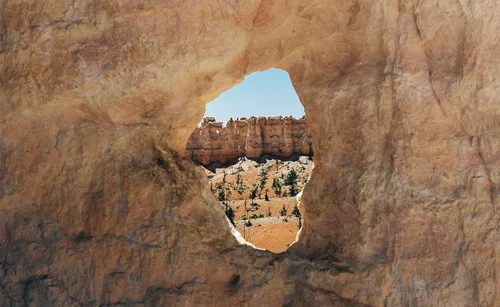
The views of the amphitheatre provide a great perspective over the edge of the plateau, which you descend into once reaching Sunset Point. As you descend, you’ll pass China Wall, a row of level hoodoos to your right. From here its a slow wind between the unique rock formations, with arches and windows framing the greater landscape. Once you reach the flat, just before the turn off to see another formation, Tower Bridge, is a shady place to stop and have a snack. Be aware that you may get a couple of unwanted guests, as the local squirrels and bluejays will come to inspect you’re goods.
Worth a little side trip is to see the previously mentioned geological marvel of Tower Bridge.! !From here is more winding, this time gradually upwards. More strange and captivating structures and viewpoints await, and you start to understand the cutsie “Fairyland” name, as everything is a bit dreamlike and unreal. The hoodoos are incredibly formed by erosion caused by the continual freezing and thawing of snow every winter, and snow capped hoodoos are a great reason to visit in the shoulder seasons. As this is one of the quieter hikes in the park you often get a lot of time in the eerily silent backdrop. Whether its the heat, dehydration or something else, by the time you return to the start at Fairyland Point, you’ll be seeing all sorts of storybook characters in the rocks.
By Joe Byrne
2018


Glacier Point and Four Mile, Yosemite National Park, California U.S.A
If you’re a fan of the Famous photographer Ansell Adams you have most definitely seen images of Yosemite National Park. Ansell Adams documented the shit out of the park through out the 20th century and little has changed, bar the decreased water levels and mass amounts of tourists. Yosemite is just as breathtaking and impressive as you might expect. On the drive in every turn provides an incredible view; if you ignore the selfie sticks. It’s very competitive to get a camp site in Yosemite Valley and tends to book up quickly especially in the summer. But while we were there was a wildfire that threatened nearby towns and the power grid that fed the whole valley, causing punters to get spooked and leaving a camp site in a prime location for us!
First thing we were told is not to leave food or toiletries in your car or tent or risk a midnight bear B & E to get your lip smackers and peanut butter cups. Don't stress, there are hefty storage lockers on each camp site. We didn't see any bears but did witness a chip heist carried out by a raccoon.
We were itching to start climbing up the impressive rocks that surround the village and planned to do the Half Dome climb. Unfortunately we missed the memo that you must enter a ballot and all spots for the next day were full. Disappointment aside we settled on combining the glacier point hike and the four mile hike to give us an appropriately challenging substitute.
The trail up to Glacier Point is steep and relatively arduous but for being peak summer it was surprisingly low on the selfie stick front. As you climb higher and higher with your ears popping like crazy there’s an endless supply of spectacularly cropped views of waterfalls and Half Dome. You feel quite like your actually in the wild for most of the incline, and although there were wildfires surrounding the park the view was not obscured at all by smoke.
Glacier Point itself is pretty hectic, all the slackers in the park have caught a bus or driven to the Point which means it gets pretty crowded. Don’t be tricked by the tons of busses coming through as they don’t go back to Yosemite valley or any of the camps, you’ll just get sassed by a driver who seems almost happy to tell you you’ve get down the way you got up…Walking.
The Four Mile track part which is your decent from Glacier point is just as spectacular as the trip up but depending on your timing you may have to jog down to try and catch the last shuttle bus back to camp. If you miss the shuttle it adds an extra 5km’s to your already 29km’s so it is worth the jog.
by Ashleigh Dwyer & Max Blackmore
2017


Cummins Falls State Park, Tennessee U.S.A
The Tennessee two-step is a famous dance in the south. It’s a jaunty jig, part line dance, and part swirl. Don’t mistake it for the Texas two-step. In Tennessee, they do it differently.
Tennessee is a very friendly town. After a local taught me the ‘Tennessee Two-step’ in a clothing store, I was told of a waterfall an hour or so away. “Best waterfall in Ten-nuh-see”, she told us. In the two-step, you hold your partner close, but you’re encouraged to twirl and bounce. If Tennessee were a dance partner, it would be the leader – friendly and familiar, but also fun and silly and exciting. Since we had nothing but time, we decided we should ‘head-ahwn down’ to Cummins Falls.
Cummins Falls State Park is the perfect summer hike. Especially since you get to have a swim in the waterfalls at the end of your walk. It’s on the Blackburn Fork State Scenic River, and it’s only a twenty-minute drive from Cookeville, or a ninety-minute drive from Nashville. When my partner and I went, we decided to stay in a Twin Peaks-esque log cabin in the small town of Cookeville.
Cummins Falls is the 8th largest waterfall in Tennessee. It was named after John Cummins, the guy who acquired the land in 1825. There’s nothing written about the original indigenous owners of the land, though it’s unsurprising - I haven’t seen much written about indigenous people in Tennessee.
The walking track to the waterfalls itself is approximately three kilometres. It’s not a long trek, but it can be trick. You need to cross rivers (sometimes with a really strong current), climb boulders and scale rocks. Make sure you don’t wear thongs, and don’t take anything too valuable, as it might get wet!
The start of the walking track is lush and dense forest. It curves down until you get to the first body of water to cross. Some of the rocks are sharp, and they’re all slippery, so walk with caution. Go at a turtle’s pace, and you’ll be cool.
On a hot summer’s day, you’ll get to the waterfall and be dying to get in for a swim. It’s pretty perfect. You can leave your stuff on a boulder and swim out and stand directly under the waterfall. You can climb up onto different sections of the waterfall (though be careful, it’s super duper slippery; a girl fell two levels while we were there) and get swept up in the sounds of water pounding on the rocks.
Making your way back from the waterfalls to go home is always a bit of a strange experience. It seems easier somehow to make your way over the rocks and through the river, back to the walking path. As soon as you’re on the path, climbing back up, it’s hard to remember the falls – they disappear in your mind as the sound of water pounding rock recedes into the distance. Instead, you begin to fall in love with the huge fir trees and shrubs that line the steep walk back to the car park. Leaving the forest, it’s easy to think it was all a dream, led by the Tennessee two-stepper itself.
By Claire Feain
2017


Ryan Mountain Joshua Tree National Park California America
If simply camping or driving through the amazing Joshua Tree National Park isn’t energetic enough for you, then a hike might be in order. One of the best and most rewarding hikes in the park is the trail up Ryan Mountain. It’s a moderately difficult hike as it is all uphill from the beginning to the end with almost no flat areas to ease your legs, but once you make it to the top, the incredible view is worth it.
Ryan Mountain is named for one of the early ranchers and mining operators in the park back in the day and is known for being the second highest peak in the park. You may also see many varieties of cacti, Joshua Trees (of course) and lizards.
On the day we went, we audaciously decided to start our hike in the mid-afternoon sun at the end of a warm summer. It is recommended that you take ample water for your hike and we drank our way through 2 litres easily. The desert conditions means there is little shade relief on your ascent so plan wisely. That means don’t forget the sunscreen!
At the beginning of the hike, there is a small rock formation that is interesting to look at, but don’t get stuck there for too long as the hike has a lot more to go. The path is well kept for the most part but there is a mild amount of scrambling over uneven rocks and very steep stairs carved out of rock. As you go higher, more and more interesting rock formations reveal themselves to you and the view over the park becomes even more spectacular.
To the north-west, enjoy the vista of The Wonderland of Rocks, and further south-west, the Little San Bernadino Mountains. The best view however, is at the peak of the mountain, once you have reached the sign and mound of rocks marking completion of the 5,457 foot summit. If you hike in the afternoon like we did, you may catch the sun setting over the Little San Bernadino Mountains, which makes for some breathtaking views and hues.
We spent far too long taking photos as the sun retreated below the horizon so our descent was mostly in the dark by the light of our headlamps. Luckily for us there were no missteps or falls but the sounds of the nocturnal desert fauna kept us hurrying on the way down.
By Eu-Jinn Teh
2015
thesilverlining.co


The Pacific Crest Trail, California, Oregon and Washington U.S.A.
The PCT is a long distance hiking trail that snakes up the West coast of America from Mexico to Canada. Around 90% of the hopeful thru-hikers start at the Mexican border heading northbound through California, Oregon and Washington. I was one of those hopeful north-bound thru-hikers, flying over solo from Australia to walk the 2650 mile (4265 km) trail.
A thru-hike involves a lot of planning and preparation. Modern ultralight backpacking was essentially conceived and pioneered on the PCT. The idea is get your base weight (all of your gear excluding food and water) down to around 5-8 kgs. As you’ll be spending up to 6 months on trail, investing in good quality, lightweight equipment is a good idea. You can either mail yourself food in boxes or you can, like most, hitch-hike into towns and resupply at markets along the way. I chose to hitch-hike and resupply as I went, familiarising myself with American products and experimenting with my diet. By the time I reached Oregon (mile 1660) I had a fairly good understanding of what my body needed and what I was/wasn’t getting sick of eating. I would recommend not boxing up food initially, it’s very hard to envisage the types of food you’ll be wanting three months down the track. Most hikers are not able to eat another pop tart after the first month. There’s plenty of resources on gear and food on the web. Yogi’s Handbook is a good starting point (http://www.yogisbooks.com/pacific-crest-trail/pct-yogis-pacific-crest-trail-handbook). The most important thing is to not get overwhelmed when you’re planning a long distance hike. Like almost everything, you learn as you go, and so long as your able to adapt and be flexible you’ll be fine. For example I started the hike with a hammock, learnt day three that that wasn’t working for me, and I had subbed it out for a tent on day 7.
Most hikers begin in April from the Southern Terminus, near a small town called Campo, East of San Diego. 2016 was the first year that the PCTA implemented a permit system, capping the number of hikers per day at 50. There are two major weather windows to consider. Firstly, the Sierra Nevada range cannot usually be passed through safely until the second week of June, once the snow starts to melt. So starting too early means that you may reach the Sierras (mile 700) and have to wait for the snow to subside. After that, you are essentially trying to outrun winter up in Washington. Most plan to finish the hike before October. Snow has closed the PCT as early as mid September in the past. I started on the 23rd of April and I seemed to be in the middle of the pack.
The Californian section of the hike is the longest (1660 miles). The first 700 miles winds through the high desert of the Mojave and the first 20 miles is a waterless stretch; you learn quickly that water management is going to be a daily challenge. It’s important to go at your own pace, many people injure themselves in the beginning because they don’t listen to their bodies. The desert was gruelling but gorgeous; dodging rattlesnakes, managing blisters, missing home and learning how to hike. You earn the views. After you leave the desert and enter into the Sierra’s a lot of hikers have already pulled out. The Sierra’s was the most epic mountain range I’ve ever hiked through. I felt like I was in another world. You carry micro-spikes and an ice axe to tackle the high mountain passes. By this time you’ve made extremely close friends and the trail community feels like a family. I actually hiked the entire trail with a dude I met on the first day of the hike.
By the time you reach Oregon almost half of the hikers have pulled out. It’s sad seeing your friends hurt and crushed by the type of commitment the hike demands. The Oregon section is a lot less undulating than California and so we started averaging 25-30 miles a day. The volcanic landscape of the Cascade’s breathes new life into the trail. Most of the time I felt like I was in Narnia. The wildflowers start blossoming and huckleberries line the trail. If California was mostly a physical battle, Oregon was a test of mental stamina. You’ve hiked for three months and you’ve still got over 1000 miles to the Canadian border. For the first time I felt the grind of the trail. You have to keep moving in order to finish before winter. It’s different when you have to wake up and hike if you want to complete what you started. Though, by this stage, we’re all pretty good at walking. Mile mania sets in and we all become crazed by the thought of reaching Canada.
The ‘Bridge Of The Gods’ connects Oregon and Washington. It’s a huge bridge that hangs over the Columbia River. Walking over it was a proud moment. Washington claims the final 500 miles of the trail and it’s almost unanimous that it also boasts the most beautiful scenery on the PCT. However, the weather starts to change. It’s an eerie feeling when you wake up in the middle of the Northern Cascades and the mist covers everything. You get up onto a ridge line and you can barely see thirty feet in front of you. Eventually the weather clears and you get a proper dose of Washington in fall. The leaves are changing colour to a burnt orange and you can hear the strange calls of elk at night. Like the leaves, the rain starts to fall. It rained for 30 hours at one point. I had to stop and hunker down on the top of a mountain in my tent that quickly filled with water. Everything was soaking wet. I rolled the last of my tobacco and waited. I was 140 miles from the Canadian border and I was in my element. I was freezing, tired, sore and completely content. I was at home. I felt alive. The colours, the birds, the rain, the rivers, the peaks, the snow; we got it all in Washington.
I reached the border at 5:30pm on the 23rd of September, 5 months after I began. I said to myself that I’d probably never attempt another thru-hike. I doubted I could commit myself to a hike like that again. That sentiment lasted a couple of days, then I missed the trail like nothing I’d ever missed before. What an epic adventure. So, it’s only natural to start planing another one! (next year I’m planning to thru-hike the Te Araroa in New Zealand).
For those considering thru-hiking the PCT, the following are some good sources of inspiration and information.
“Do More With Less” - Documentary - http://domorewithlessfilm.com
PCT annual survey - http://www.halfwayanywhere.com/trails/pacific-crest-trail/pacific-crest-trail-thru-hiker-survey-2016/
by Mathew Bate
2016


